Mattress construction
Natural Latex Bed Layers: What Their Construction Means for Feel and Support
A latex mattress is often described as buoyant, responsive, or naturally supportive, as though a single adjective could account for the whole bed. In practice, its feel emerges from a more prosaic—and more useful—set of decisions: how many layers it contains, how thick they are, where firmer material sits, and whether the components can be rearranged. The construction is the story. The label is only its cover.
Shopping for a mattress involves a peculiar act of translation. A person lies down, briefly, in a brightly lit room; a salesperson offers a word such as “medium”; and the shopper is asked to imagine how the bed will feel at two in the morning, after several hours in one position, with a shoulder bearing weight and the rest of the body making its quiet demands. With natural latex beds, the translation can be especially difficult. “Latex” tells you something about the material, but not enough about the experience.
Two beds may both contain natural latex and nevertheless feel markedly different. One may meet the body with a quick, springy pushback. Another may allow a deeper, softer cradle. A third may feel firm at first contact but give a little more beneath the hips or shoulders. These distinctions are not mysterious, nor are they reliably explained by organic terminology alone. They begin with the arrangement of the layers.
Understanding that arrangement is useful whether you are comparing organic latex mattresses, considering a customizable bed, or trying to make sense of a firmness chart that seems written for someone else’s body. Layer count, thickness, firmness, latex type, and the materials above or below the latex all help shape the result. None offers a perfect prediction on its own. Together, they provide a practical way to ask better questions.
The mattress as a small landscape
It helps to picture a layered latex mattress not as a block but as a landscape with different levels. The uppermost layer is the first terrain the body encounters. It may soften the initial contact and allow the shoulders, hips, and other pressure points to settle. Beneath it, a middle layer can mediate the transition between surface comfort and deeper support. The bottom layer forms the foundation, resisting excessive sink and helping the bed retain its shape under load.
That division is a useful shorthand, not a law. The layers do not operate as isolated departments. A soft top over a firm base does not produce exactly the same sensation as a single medium layer; nor does a thick comfort layer behave like a thin one. The body compresses the stack as a whole. The depth and character of that compression depend on a sleeper’s size, shape, position, and movement, as well as on the latex itself.
Still, the distinction between comfort and foundation can clarify a confusing specification sheet. If a mattress feels too hard at the surface, the issue may be the firmness of the upper layer, not a lack of support underneath. If the hips descend too far, the trouble may lie in the overall arrangement, the thickness of softer material, or the interaction between the mattress and its base. A bed can be both soft at first contact and supportive deeper down; softness and support are not opposing virtues.
Firmness describes a sensation, while support concerns how the mattress holds the body in a usable position. They are related, but they are not interchangeable. A very firm surface can still feel uncomfortable if it does not accommodate a sleeper’s contours. A softer surface may be supportive if its deeper structure prevents the body from sinking too far. This is why a single firmness number, though convenient for comparing products, should be treated as a rough map rather than a verdict.
What the number of layers changes
A single latex layer offers a relatively direct feel: what happens at the surface is closely tied to the material’s own firmness and thickness. A multi-layer design can create more distinct stages of give. The upper layer may provide the first impression; a firmer layer beneath it may limit deeper compression; and the base may stabilize the structure. In theory, this gives a designer more ways to tune the bed. In practice, the number of layers alone does not tell you whether the tuning will suit you.
Three layers, for instance, do not automatically mean three clearly perceptible sensations. The layers may be similar in firmness, or the upper one may be thin enough that the body quickly engages what lies beneath. Conversely, two layers can feel quite different from each other if they are substantially different in firmness or thickness. The useful question is not simply “How many layers?” but “What does each layer contribute, and how do they work together?”
More layers can bring practical advantages when they are removable or rearrangeable. If the mattress has a zippered cover and distinct components, a sleeper may be able to change the order or firmness of the layers, depending on the manufacturer’s design. A customizable system can make adjustments less drastic than replacing an entire mattress. But it also asks the buyer to make a series of choices, and the first configuration may not be the right one. Exchange policies, adjustment instructions, and the conditions attached to any trial period therefore matter as much as the menu of firmness options.
A fixed-layer mattress may be simpler. Its construction is settled, and the shopper need not become an amateur mattress engineer before going to bed. The trade-off is reduced flexibility if the feel proves unsuitable. There is no universally superior design here. A layered system is valuable when its choices are meaningful, clearly explained, and realistically adjustable; a fixed construction can be perfectly sensible when its feel and materials fit the sleeper’s needs.
Thickness, contouring, and the question of sink
Thickness influences how much room the body has to compress a layer before meeting firmer material underneath. A thicker soft layer may create a more pronounced cushion, though the result also depends on its firmness and on the layer below. A thinner comfort layer may produce a closer-to-the-surface feeling, with the mattress’s underlying structure becoming apparent sooner. Neither is inherently better. The right balance depends on how much contouring a sleeper wants and where their body needs it.
Side sleepers commonly place substantial pressure around the shoulders and hips. A surface that allows those areas some accommodation can help reduce the sense of being pressed against the bed. Back sleepers may prefer enough contouring to feel held without allowing the pelvis to drop excessively. Stomach sleepers often look for a firmer, more even surface, although individual comfort and body proportions vary. These are starting points, not rules that can replace testing a mattress or understanding its return and exchange terms.
Body weight also changes the way a mattress is experienced. A lighter sleeper may not compress a layer as deeply as a heavier one, and may perceive a given construction as firmer. A heavier sleeper may engage more of the mattress’s depth and experience a different balance of cushioning and resistance. Two people can lie on the same bed and disagree in good faith about its firmness, because the mattress is not meeting two identical bodies.
Latex is often described as responsive: it tends to return toward its original shape relatively quickly after pressure is removed. For some sleepers, that makes it easier to change positions than on a surface that yields slowly. The sensation is frequently compared with buoyancy or gentle pushback, though those words can obscure as much as they reveal. A thick, softer latex layer may feel more cushioning; a firmer or thinner arrangement may feel more immediately supportive. “Responsive” does not mean “firm,” just as “contouring” does not necessarily mean slow or deeply enveloping.
Firmness labels, and what they leave out
Terms such as soft, medium, and firm are easy to print on a product page. Their meaning is less stable. Manufacturers may use different scales, and the same label can describe beds with different constructions. Even within one mattress, a “medium” feel may come from a soft upper layer over a firmer base, from layers of moderate firmness throughout, or from a different combination altogether.
When a listing offers layer-by-layer firmness, read it as a description of architecture rather than a promise of a particular sensation. A common arrangement might put a softer layer on top and firmer layers beneath; another may use a medium layer at the surface with a firmer foundation. The order can matter. If layers can be rearranged, ask whether the mattress is designed for one orientation or allows more than one configuration. Do not assume that any sequence is recommended simply because it is physically possible.
It is also worth distinguishing firmness from durability. A firm layer is not automatically more durable than a soft one, and a natural or organic claim does not by itself establish how a mattress will perform over time. Construction details, material specifications, care instructions, warranty terms, and independent evidence all have different roles. A mattress can be made with natural materials and still be the wrong firmness; it can also feel comfortable while having limited adjustability. These questions should not be collapsed into one claim about quality.
When product information is vague, look for the specifics behind the adjective: the thickness of each layer, its firmness options, whether the components are interchangeable, what the cover contains, and how the manufacturer describes the intended configuration. If these details are absent, “medium” may be all you have—and it is reasonable to treat that as an uncertainty rather than a feature.
Dunlop and Talalay: process, not a comfort guarantee
Natural latex mattresses may use Dunlop latex, Talalay latex, or a combination. These names refer to different manufacturing processes. Product descriptions often associate them with distinct qualities, but a process name cannot tell you, by itself, how a finished mattress will feel. Firmness, layer thickness, formulation, and placement in the bed remain central. The practical question is not which word sounds more luxurious; it is how the material is used in the particular construction you are considering.
Some mattresses allow shoppers to select between latex types for particular layers, while others use one type throughout. If a maker offers that choice, ask what difference the option is expected to make and whether the selection changes the firmness or the character of the surface. Be wary of treating a material label as a shortcut around personal preference. The same broad category of latex can be configured in more than one way, and “natural” is not a firmness scale.
Organic claims also deserve careful reading. Certifications can concern particular materials or stages of production, and their scope may differ. A mattress described as organic may contain several components, each with its own specification. Review the certification information provided by the manufacturer rather than assuming that one adjective applies equally to every part of the bed. This is not a reason for suspicion; it is simply a way of making a more exact comparison.
Examples of layered construction
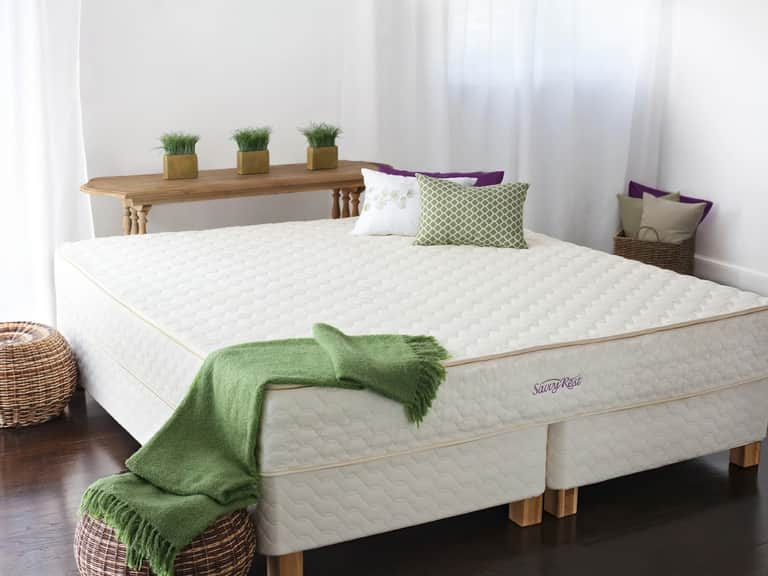
The Savvy Rest Serenity Latex Mattress illustrates the appeal of a configurable, layered design. It is described as a 10-inch mattress with three layers of Dunlop and/or Talalay latex, available in soft, medium, or firm options. Its cover is made with organic cotton and includes organic wool quilting. Queen- and king-size models can be configured by side, which may be useful for partners who do not share the same firmness preference. The construction makes the division between selectable layers explicit; it does not guarantee that a particular combination will suit every sleeper. Buyers should confirm the available configurations and exchange terms before ordering.
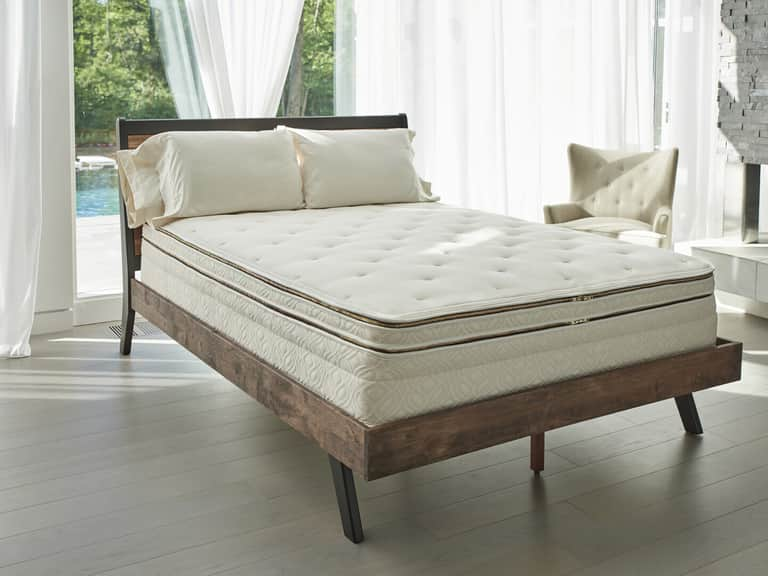
A different arrangement appears in the Naturepedic Arcadia Hybrid Organic Mattress, which combines latex with wrapped coils. Its listed construction includes six inches of organic Dunlop latex and six inches of organic wrapped coils, within a 13-inch profile, along with a wool, alpaca, and cashmere blend layer. Firmness can be selected, and some larger sizes offer different firmnesses on each side. This is not an all-latex mattress; it is an example of how latex may serve as part of a broader support system. The coils form a distinct foundational element, so comparisons with an all-latex bed should take that difference into account.
Neither example can settle the question of what you will find comfortable. Their value here is as illustrations of two different construction approaches: one centered on adjustable latex layers, the other pairing a substantial latex component with coils and natural-fiber materials. In both cases, a detailed specification is more informative than a generic promise about softness, luxury, or sleep quality.
The cover and the layers around the layers
The latex core is not the entire sleep surface. A mattress cover, quilted materials, and any topper or protector can alter how the bed feels at first contact. Wool or cotton in the cover may add a small amount of cushioning and affect the texture or temperature experience. A thick topper can change the feel more substantially, while a thin protector is generally intended to shield the mattress with less effect on its underlying character. The result depends on the materials and construction, so “latex feel” is not always a description of latex alone.
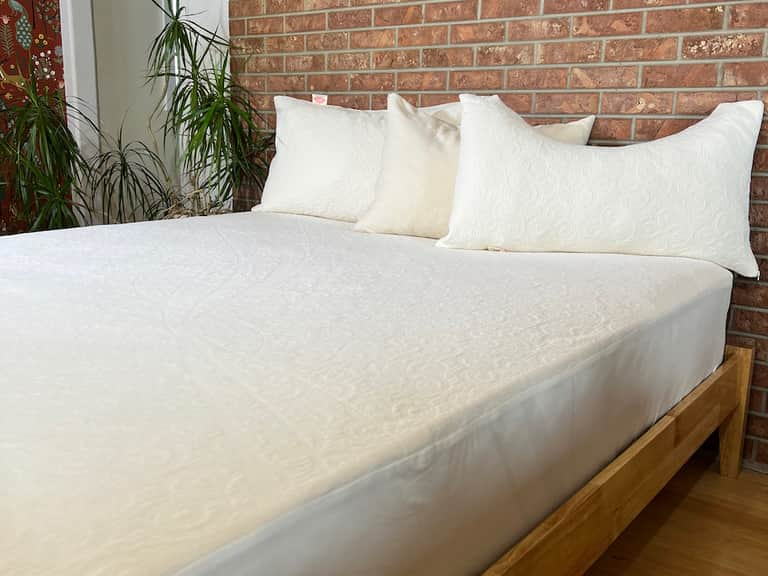
A protector is particularly relevant to a layered mattress with a removable cover. The Suite Sleep Organic Cotton Knit Mattress Protector is made from organic cotton jersey and has a stretch-knit design intended to fit mattresses up to 18 inches deep. A fitted protector can help guard against everyday dirt and wear, while a flexible knit is designed to follow the shape of the mattress rather than add a thick padded layer. Check the care directions and fit before use, and bear in mind that any added layer can slightly influence the surface sensation.
Adjustable bases introduce another consideration. A mattress intended to flex with an adjustable base must be compatible with that foundation, and the cover and layer assembly should move without bunching or shifting in ways that interfere with comfort. Compatibility is a manufacturer-specific detail, not something to infer from the word “latex.” If an adjustable base is part of your setup, verify it directly before purchasing.
A practical way to compare natural latex beds
It can help to compare mattresses with a short checklist, rather than trying to remember a parade of showroom impressions. The aim is not to turn comfort into a mathematical problem. It is to keep important distinctions from disappearing beneath attractive language.
- Map the layers. Record each layer’s material, thickness, and stated firmness, from top to bottom.
- Identify the foundation. Find out whether the base is latex, coils, or another support component, and how it is intended to work with the upper layers.
- Ask about adjustment. Confirm whether layers can be rearranged or exchanged, which configurations are recommended, and what the exchange conditions are.
- Think in sleeping positions. Consider where you feel pressure and whether you prefer a close cradle or a more buoyant, lifted sensation.
- Account for body weight and partners. The same firmness label may feel different to different sleepers; check whether side-to-side customization is available if relevant.
- Read the fine print. Review certifications, care guidance, warranty coverage, trial periods, delivery arrangements, and any limitations stated by the maker.
- Consider the whole surface. Include the cover, protector, topper, and bed base in your evaluation, not just the latex layers.
If you can test the mattress, give the test enough time to be informative. A brief sit or a few minutes on your back tells you little about how the bed behaves when you settle into your usual position. Notice the first contact, then ask whether your shoulders or hips feel crowded, whether your lower back feels comfortably held, and whether changing position is easy. These observations are personal, but they are more useful than trying to guess what a manufacturer means by “luxurious.”
For an online purchase, the trial and exchange policy becomes part of the product. Learn when the period begins, whether a minimum adjustment time applies, who pays for transportation, and whether changing a layer is different from returning the mattress. A customizable bed is not truly low-risk merely because it can be adjusted; the details of adjustment determine how useful that flexibility will be.
What construction can—and cannot—tell you
Layer specifications can narrow the field. They can show why two mattresses with similar materials may behave differently, and they can help explain why one bed feels gently cushioned while another feels more immediate and springy. They can also make a comparison fairer: a three-layer customizable mattress and a latex-and-coil hybrid should not be treated as equivalent merely because both mention natural latex.
Construction cannot predict comfort with certainty. People differ, mattresses are experienced in context, and even a thoughtful description has limits. A sleeper’s pillow, foundation, room temperature, bedding, and habits all form part of the experience. The point of studying layers is not to discover a secret formula that guarantees perfect sleep. It is to replace guesswork with informed questions.
Natural latex beds are at their most understandable when their makers explain not only what materials they use but where those materials sit and what each layer is meant to do. A clear account lets a shopper compare a softer surface over a firm core with a uniform medium construction, or an all-latex arrangement with a hybrid that places coils underneath the latex. It gives words like “support” and “pressure relief” a physical context.
In the end, the mattress is less a monument to a material than an arrangement of choices. The natural latex matters. So do the inches above it, the firmness beneath it, the manner in which the layers meet, and the body that settles there. Once those details come into view, the search becomes less like trying to decode an advertisement and more like reading a piece of useful engineering: not a guarantee of comfort, but a much clearer account of how comfort might be made.